
Get your catalogue seen on Google Shopping, Search and AI assistants
I fix the product data behind your listings, from Merchant Center disapprovals to titles, attributes and structured data, so Google and AI shopping tools can match your products to the searches that convert.
Where catalogues lose clicks
In the accounts I audit, visibility problems usually trace back to a few product data issues that repeat across thousands of SKUs, which is why fixing them at the template and feed level pays back faster than fixing products one by one.
Disapproved and limited listings
Policy flags, missing identifiers and landing page errors stop products from serving, and Merchant Center diagnostics don’t tell you which ones cost the most revenue.
Titles and attributes Google can’t match
Titles without brand, material, size or colour, an empty product_type and thin attributes keep products out of the specific queries buyers type when they’re ready to purchase.
Feed and site out of sync
When price, availability or structured data on the product page disagrees with the feed, Google can restrict or disapprove the listing until the two match.
Pages working against the feed
Faceted URLs, duplicate variants and weak internal linking split ranking signals between pages that should be supporting the same products in organic search.
AI assistants read the same product data
ChatGPT, Google AI Mode, Perplexity and Gemini build product recommendations from feeds, structured data and what’s written on your pages. When price, stock or key attributes are missing or contradict each other, the assistant has less to go on when it decides which products to name.
Feed work and technical SEO in one engagement
The data that ranks your product pages is the same data that feeds your Shopping listings, so I work on both sides together.
01Merchant Center audit
Account health, disapprovals, policy issues and feed errors, each ranked by the revenue it puts at risk and paired with the exact fix.
02Feed rebuild and title optimisation
Title structures per category, attribute completion, GTIN and MPN handling, product_type and custom labels that give your campaign manager real control over product groups.
03Product and category page SEO
Technical fixes on the pages your listings land on: indexation, variants, faceted navigation, internal linking and copy written around how buyers search for your products.
04Structured data and AI search visibility
Product, Offer and review markup aligned with the feed, so search engines and AI assistants read the same price, stock and attributes wherever they look.
05Product data architecture
A setup sized to your catalogue, with a clear view of when to move from native sync to a feed platform, and when a PIM upstream starts paying for itself.
From audit to fixes you can measure
Questionnaire and access
A short pre-audit questionnaire on your catalogue, markets and channels, plus read-only access to Merchant Center, Search Console and analytics.
Audit and priority list
A written audit with every issue scored by impact and effort, so your team knows what to fix first and why.
Implementation sprints
Monthly sprints with a defined focus, where I ship the fixes directly or work alongside your developers and feed team.
Review and next focus
Each month closes with clicks, impressions and revenue by product group, and an agreed focus for the next sprint.
Catalogues I fixed
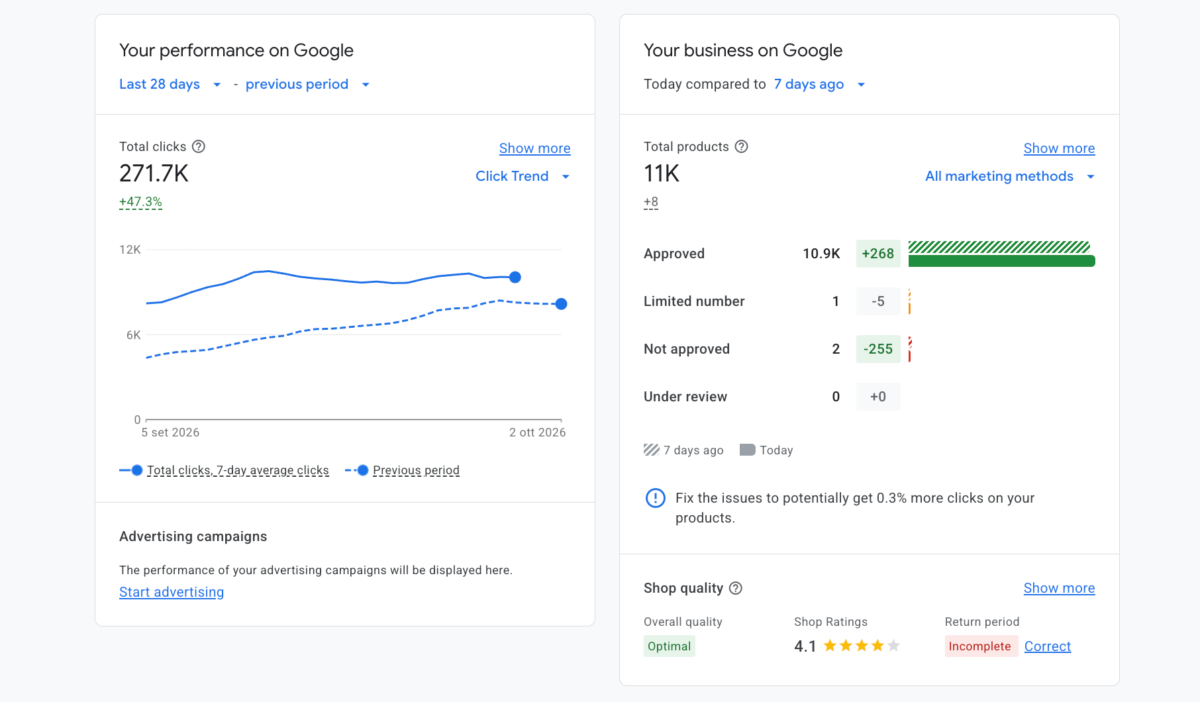
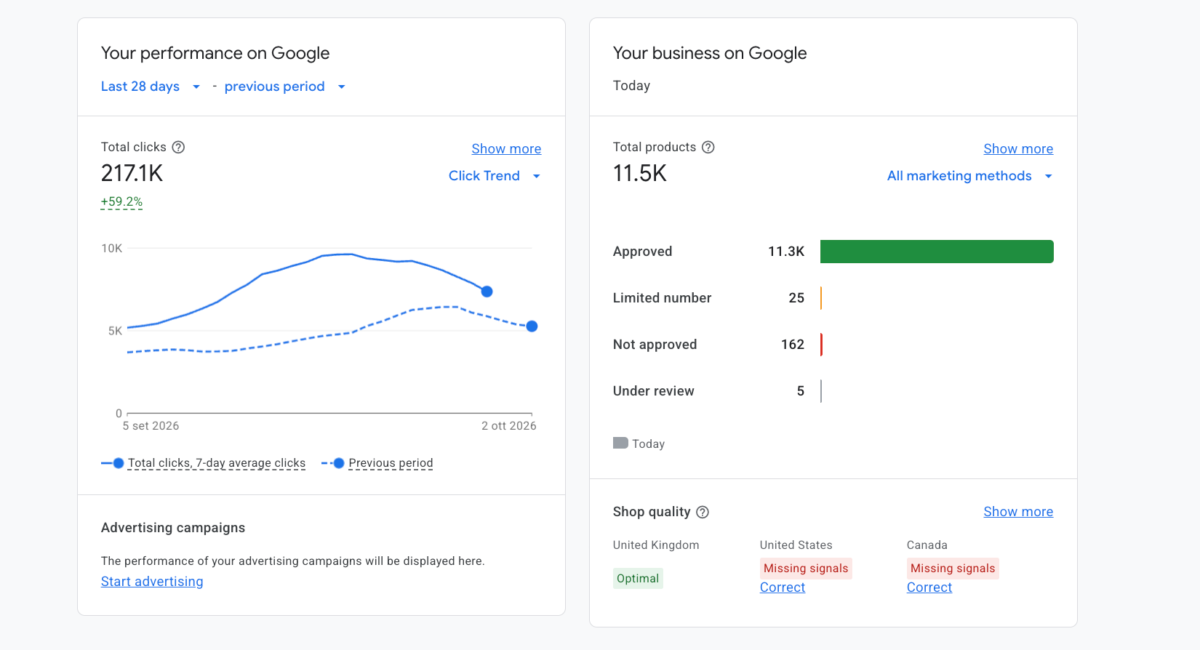
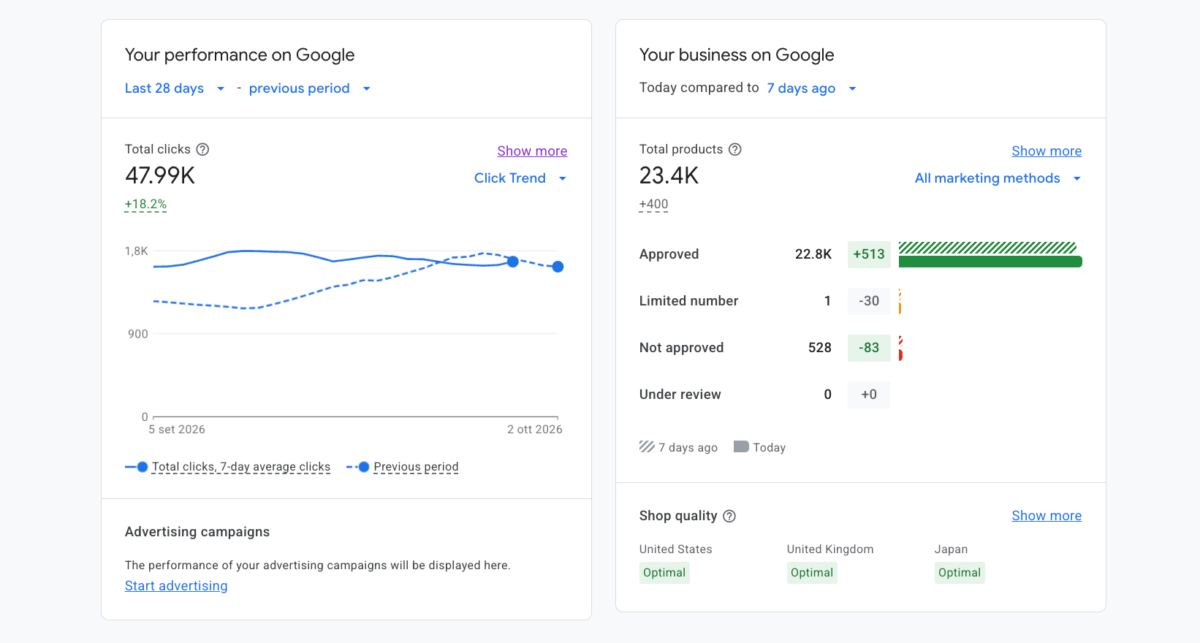
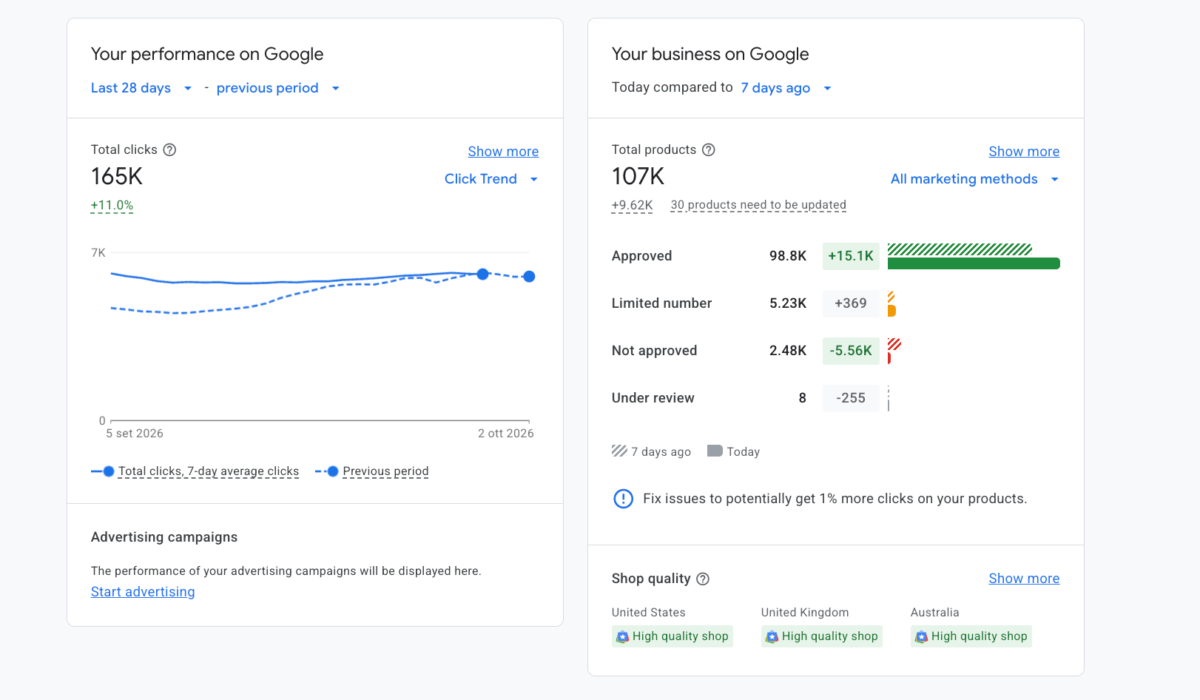
Four client Merchant Center accounts, with none of them running ad campaigns, so every click here comes from free listings. Clicks compare the last 28 days with the previous period (5 September to 2 October 2026); product status compares today with seven days earlier.
Find out which products aren’t showing, and why

Simone Parodi
I’ve worked as an independent ecommerce SEO consultant for over four years, with medium and large brands in fashion, furniture, food and wine across many markets, both directly and as a white-label partner for agencies.
Questions brands ask before the audit
What does the Merchant Center audit cover?+
Account health, disapprovals and policy warnings, feed errors, missing attributes and identifiers, price and availability mismatches with your site, and title structure for your top categories. Everything comes back as a priority list ranked by revenue impact.
What access do you need?+
Read-only access to Merchant Center, Search Console and analytics is enough for the audit. For implementation we agree on access based on who ships the fixes.
We sell private label products without GTINs. Is that a problem?+
Products without a manufacturer GTIN can still serve. We set the identifier fields correctly for your case and lean on brand, MPN and complete attributes so Google can understand and match the product.
Can you work with our developers or agency?+
Yes. I can hand over a prioritised fix list for your team to implement, or work inside your process as the person responsible for product data and SEO.
Do you manage Shopping or Performance Max campaigns?+
No, I don’t run ad campaigns. My focus is the product data and the pages behind them, which is what your ads depend on. I work alongside whoever manages bids and budgets, and the custom labels we set in the feed give them better control over product groups.
Do you work with multiple countries and languages?+
Yes. I work with clients globally, and several of the catalogues in the results above sell across multiple markets, including the US, UK, Japan and Australia.
How soon will we see results?+
Disapproval fixes can show up shortly after Google re-reviews the affected products. Title and attribute changes usually need a few weeks of data before the effect on impressions and clicks reads clearly.
Tell me about your catalogue
Send your store URL and a line on what’s going wrong in Merchant Center. I read every message myself and reply within [X] working days.