The Complete Guide to Seasonal E-commerce SEO
Most e-commerce businesses are unknowingly destroying their SEO rankings every year.
They create high-performing seasonal campaigns, watch them rank and build authority, then delete everything when the season ends.
Here’s why that’s costing you thousands in lost revenue, and how to fix it.
How to understand seasonal search trends
First of all:
- Understand when peaks happen and what causes them.
- Measure how big those peaks are compared to your baseline demand.
- Identify which products are affected by seasonality.
- Evaluate how reliable your forecasts really are.
Use Google Search Console and Google Analytics 4 and filter for the past 16 months or longer. You can view repetitive peaks across these time periods.
This method helps you view the past, think ahead, and act early.
Try viewing the following in GA4 and Google Search Console:
- Annual click-through and impression rates
- Year-over-year ranking comparison
- Year-over-year organic traffic comparison
- Year-over-year conversion comparison
- Year-over-year trend analysis
If you want a complete overview, you can use an SEO tool like Ahrefs or Google Trends, or analyze social media and competitor activity.
Social media is a gold mine; you can anticipate demand for your ecommerce business.
For example, we’ve often seen on Instagram and TikTok a surge in hashtags for particular trends/products.
In this case, you can create a specific page/category to target the term first.
Then, it is important to understand the three seasonal cycles:
- Weekly seasonality → Many sales occur in the first part of the week
- Monthly seasonality → In general, people spend money when they receive their salaries (at the start and end of the month)
- Year-over-year seasonality → During Q4, sales increase significantly
Seasonality is not only about Christmas and Black Friday; it also includes periods when the business experiences peaks or losses in traffic or conversions that repeat year over year without a clear reason.
Therefore, it is important to analyze shopping habits both online and offline, ensuring you are present at the right time.
Also, pay attention to market changes, for example, COVID-19 transformed the entire market.
Take into consideration:
- Events
- Seasons
- Special sales
- International days
- Financial factors
- Celebrations
- Holidays
Create a calendar that includes these considerations.
Seasonality is Tricky
Seasonal planning becomes significantly more complex when scaling internationally.
What works as a high-impact campaign in one region may fall flat in another due to misaligned holidays, cultural nuances, or even opposing climates.
Consider Father’s Day:
- In Italy, it is celebrated on March 19th.
- In the United States, it falls on the third Sunday of June.
- In Russia, it is observed on February 23rd.
The same logic applies to “Back-to-School” windows.
While many European and North American markets focus on September, academic calendars vary drastically worldwide.
Furthermore, you must account for hemispheric inversion.
While Europe enjoys summer in June, Australia is in the depths of winter. Meanwhile, equatorial regions, such as Kenya, Mexico, and Papua New Guinea, maintain tropical climates year-round.
If your SEO and marketing strategy doesn’t account for these geographical shifts, you risk promoting products that are physically irrelevant to your target audience.
Understanding Cultural Differences in Online Shopping
- Power Distance – Equality-focused cultures want detailed info; hierarchy-focused cultures prefer interactive sites.
- Individualism vs. Collectivism – Different cultures focus on personal needs; others prioritize community benefits.
- Masculine vs. Feminine – Competitive cultures value success messaging; cooperative cultures prefer quality-of-life appeals
- Uncertainty Avoidance – Some cultures need clear communication; others accept ambiguity and emotion
- Time Orientation – Present-focused vs. future-focused cultures respond to different promotional strategies
- Indulgence vs. Restraint – Restrained cultures are pessimistic; indulgent cultures are optimistic
Key takeaway: Marketing strategies must adapt to these cultural values for effective international e-commerce.
In general, out of curiosity, I’ve learned that different markets from mine operate differently. For example, Chinese ecommerce is quite different from European ecommerce.
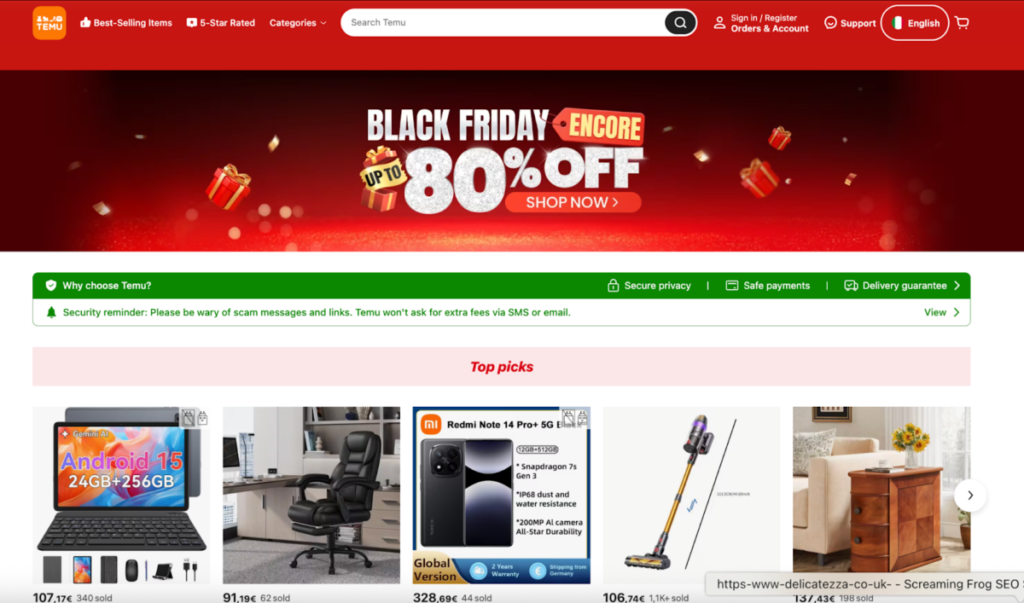
When running an international e-commerce business, adapt these key elements to each culture:
- Communication style – Germans require formal address (Sie, Frau, Herr); Americans prefer casual “you”
- Color meanings – Blue = professional (US) vs. cold (East Asia); Red = luck (China) vs. love (US); Black = mourning (West) vs. happiness (elsewhere).
- Values – German/Scandinavian shoppers prioritize sustainability; importance varies by market.
- Advertising approach – Germans want detailed facts and comparisons; Americans prefer practical benefits and testimonials
Don’t copy-paste marketing across borders. Understand cultural differences to connect with customers and avoid costly mistakes.
Every marketing project begins with thorough data analysis.
Effective analysis combines data-driven, preventive methods with qualitative and quantitative approaches, examining competition, target audiences, and the company itself.
During this phase, asking questions includes:
- Company mission, vision, and objectives
- Product/service lifecycle stage
- Competitive landscape
- Market pricing (supply and demand dynamics)
- Target audience definition
- Industry trends
In general, I note all in a document.
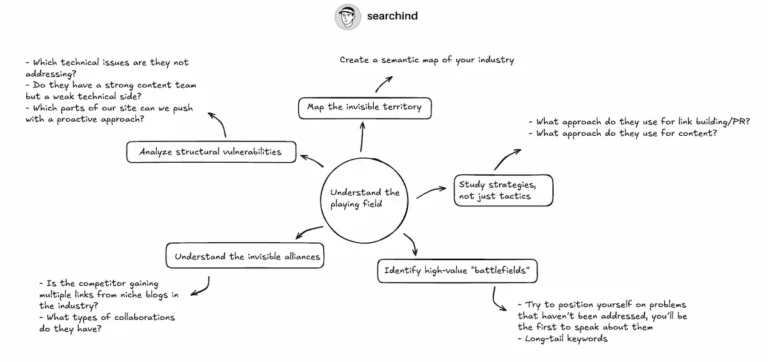
Market and competitor analysis
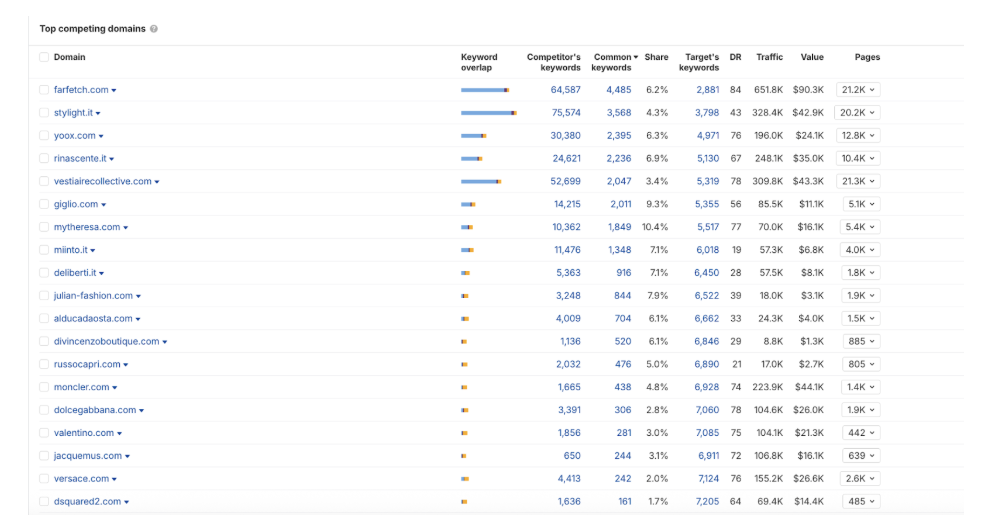
The recommended strategy is to identify 6–10 market-leading competitors within your niche that offer similar product catalogs and demonstrate strong organic positioning.
For a quick overview, you can use Ahrefs.
The Ahrefs dashboard provides a list of “Organic Competitors,” though these automated results should be taken with a grain of salt as they often include broad marketplaces or irrelevant domains.
To refine your list, you should manually identify competitors without relying solely on software:
- SERP Analysis: Search for your core “money” keywords in an incognito window. The stores consistently appearing in the top five spots are your true organic rivals.
- Google Search Operators: Use the
related:domain.comcommand to find websites that Google’s algorithm categorizes as similar to yours. - Social & Community Pulse: Monitor who your target audience mentions or tags on platforms like Instagram and TikTok, as these brands are often “rising stars” that tools haven’t fully indexed yet.
What you can analyse:
- For SEO:
- Seasonal content and SEO optimization
- Site structure and navigation flow
- Organic traffic sources and channels
- Most visited pages
- Traffic peak periods
- Keyword positioning strategies (yours vs. competitors)
- Off-site profile and backlink quality
- Competitor advertising activities (ads, social media, influencer marketing)
- For promotional campaigns:
- Communication methods and budget allocation (if possible)
- Channels and campaign types activated
- Duration and effectiveness of promotions and discounts
- Sales progression driven by promotions
Reviewing past performance helps identify successes, mistakes to avoid, and guides future investment decisions toward profitable strategies.
Below, I’ll show you a real case study to apply these different methods.
Maintain a good technical SEO for Seasonal Campaigns
Strong technical foundations are essential for seasonal campaign success.
When high-traffic periods arrive, your site needs to handle increased demand while remaining easily discoverable by search engines.
I don’t talk much about this topic because not the core of this article.
Below, you need to have the basics that work very well:
- Crawlability: Help search engines discover your seasonal content
Make it easy for search engines to find your campaign pages quickly.
Submit updated sitemaps whenever you launch new seasonal content to accelerate the crawling process.
Maintain clean, logical URL structures that guide search engines efficiently to your newest offerings.
Tools like Screaming Frog can help identify potential crawlability issues before they impact your seasonal campaigns.
- Indexability: Ensure your seasonal pages rank in search results
Getting crawled isn’t enough; your pages need to actually appear in search results.
Monitor for indexing problems regularly using website audit tools to catch issues early.
Implement structured data markup to qualify for rich results that stand out on search engine results pages.
- Performance: Deliver fast experiences during peak traffic
Site speed becomes critical when seasonal traffic surges.
Run regular speed tests and address bottlenecks by compressing images, minifying code, and eliminating unnecessary scripts.
Since mobile devices account for the majority of seasonal searches, prioritize mobile optimization to ensure smooth browsing experiences across all devices.
Structure your seasonal content strategically
Consider creating a dedicated hub for seasonal campaigns on your site. This centralized approach keeps content organized and improves user navigation.
Strengthen your SEO further by linking seasonal pages to relevant evergreen content, distributing link equity across your site while providing users with additional value.
Management of expired products
This is a meticulous topic because each e-commerce platform needs specific attention.
Below, you can find my framework, which adapts in many cases also for seasonal products.
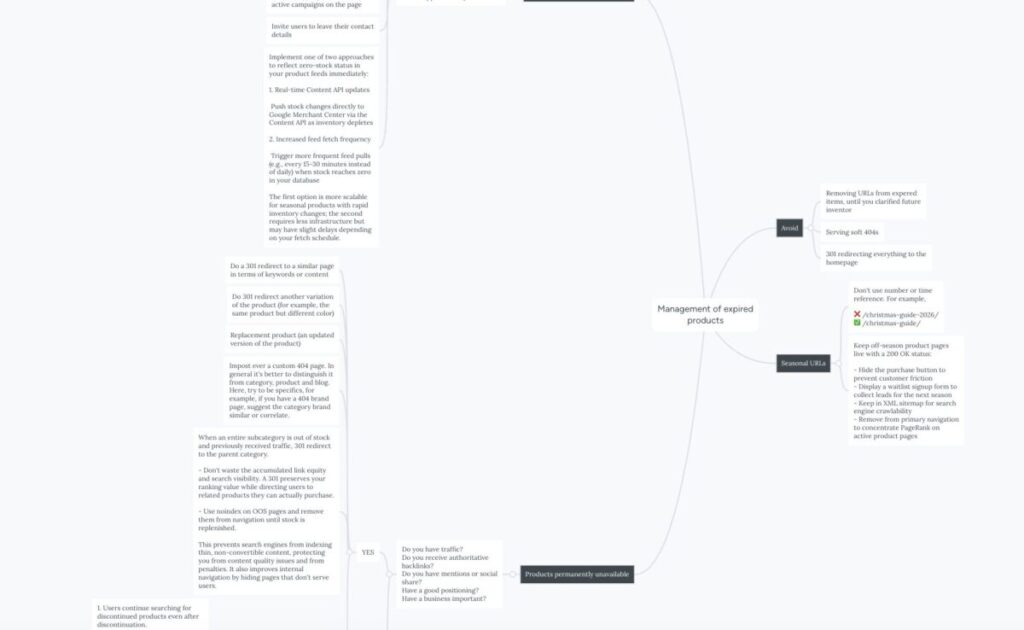
Maintain a good architecture
If you are in Black Friday week, these solutions could be useful for you. Add “Black Friday” to the menu with appropriate colors.
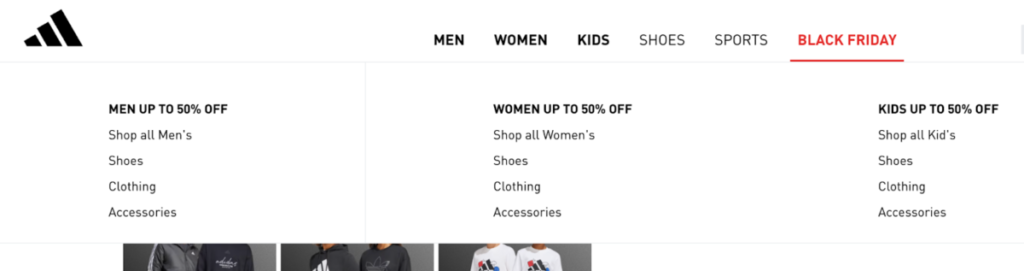

In this case, I recommend using this structure:

Why?
If you have a specific URL and page that targets only “Black Friday,” it will be more relevant for positioning, and users will better understand the structure.
Stop deleting your seasonal pages – it’s SEO suicide
While everyone’s obsessing over conversion rates, they’re accidentally nuking their search rankings with one simple URL mistake…
Here’s what’s happening:
→ You create amazing seasonal sale pages → They start ranking and building authority → Then you DELETE them after the campaign → All that SEO juice?
Gone forever.
The mistake that’s costing you rankings:
❌ Using URLs like: /black-friday-2024-sale (with date)
❌ Creating new sales pages every year
❌ Letting seasonal pages disappear into the void
The million-dollar fix:
✅ Use evergreen URLs: /seasonal-sale or /holiday-deals
✅ Keep the same page structure year after year
✅ Update ONLY the content and metadata
✅ Implement proper canonical tags on your main product pages
Why this works:
- Your seasonal pages compound authority annually
- Link equity stays intact
- No duplicate content penalties
- Off-season pages can redirect traffic to current promos
Pro tip: When the sale ends, don’t delete the page. Update it to showcase your current deals instead.
Your seasonal campaigns should be SEO assets, not one-time expenses.
The role of inbound
For ecommerce clients, I often suggest building a solid brand with inbound marketing. It’s slow, but in the long term, you’ll achieve strong results.
In general, you know that people buy in three ways:
- Those who buy before the season
- Those who buy during the season
- Those who buy after the season
To capture this traffic, you must have:
- A marketing plan
- An activity calendar plan → Here, build a Google Sheet with the client’s seasonality data
Many eCommerce businesses don’t have a specific guide to target these phases.
For example, having a good content plan for social media, email, and blog can help you target people who buy in these three ways.
You can use this template to manage content.

Below, I’ll show how to use inbound marketing with a real case study.
Case study
This ecommerce business sells panettone in Italy.
In Italy, panettone is a must-have in every house when Christmas arrives.
Google trends
The term “panettoni” in Google Trends shows the precise seasonality of this product. Searches for “panettoni” often start from August-September.
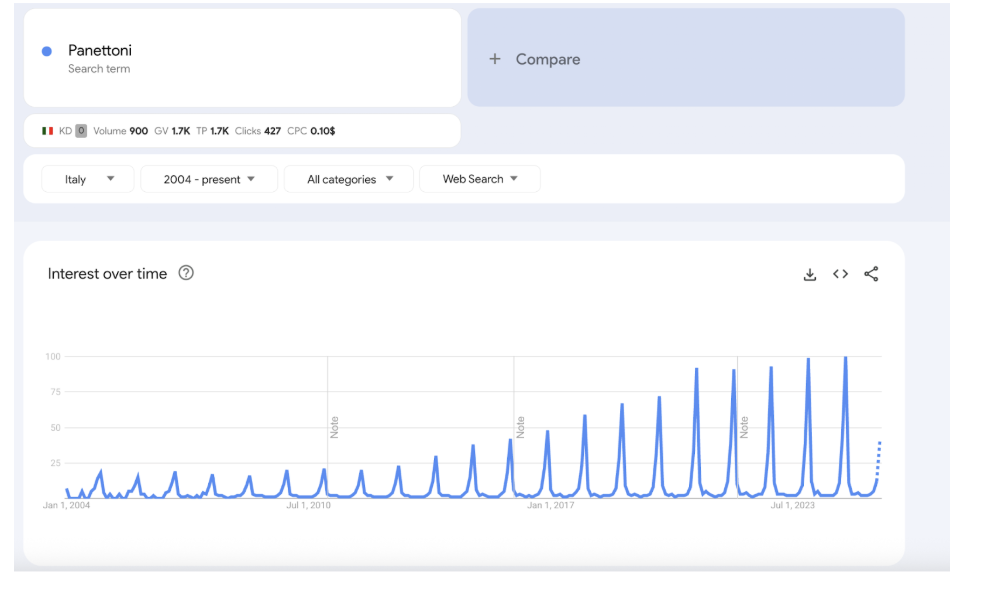
What’s important here is that people research the product to gain a good understanding before buying.
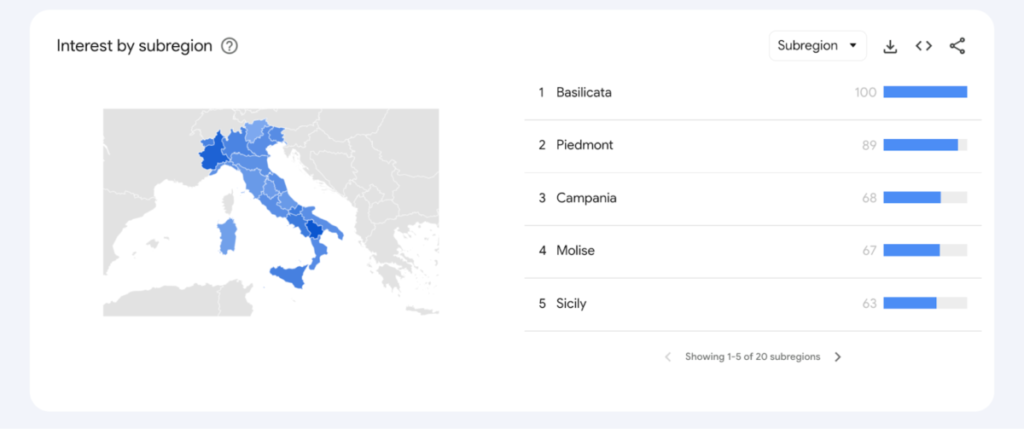
If you scroll down, you can see that each region has different importance levels.
Here, you can consider whether to also create regional content or whether the business should think about regional targeting.
In our case, we didn’t pursue this approach because the business had different goals.
Amazon
Amazon is very good for ecommerce keyword research.
In this case, if you search “panettoni” on Amazon using a good extension (Helium 10), you can see different opportunities. For example, “panettoni artigianali” is growing well.

And if you expand the overview, you can evaluate average revenue, price, and more.
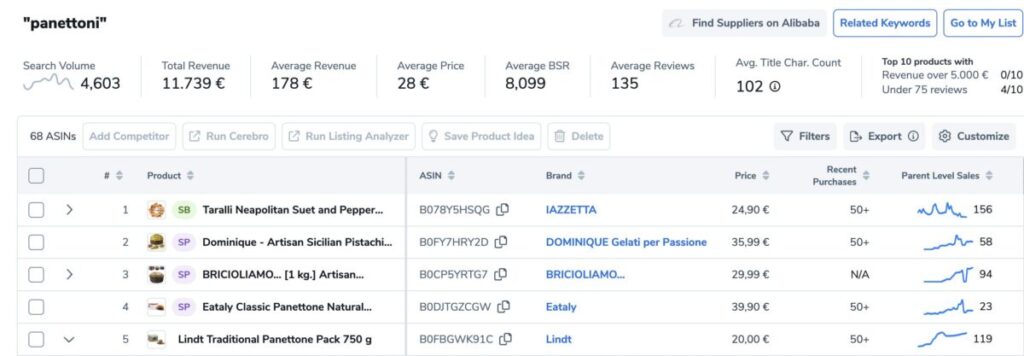
In our case, we had a good price and sold panettoni in a complete box. But it’s important to have a complete overview of the market.
Other platforms and socials
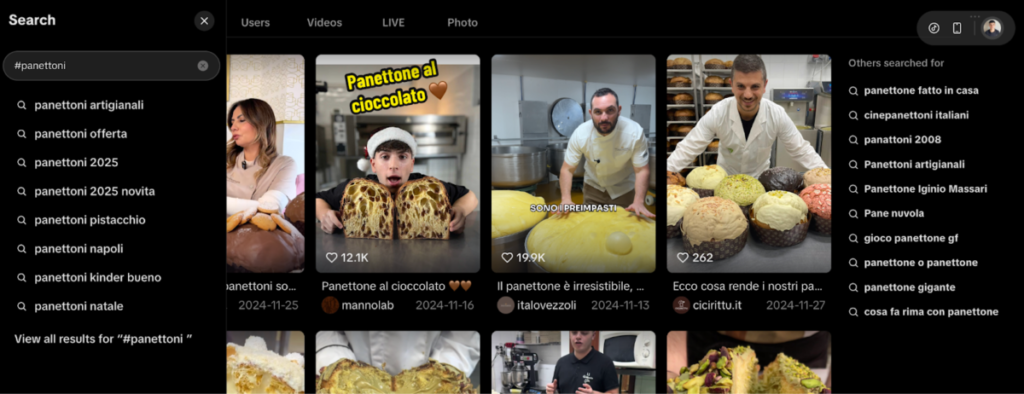
It’s important to see what happens in the complete organic landscape.
In our case, I looked at TikTok, Instagram, Pinterest, etc.
On Pinterest, people search for ideas, and in many cases, they buy!
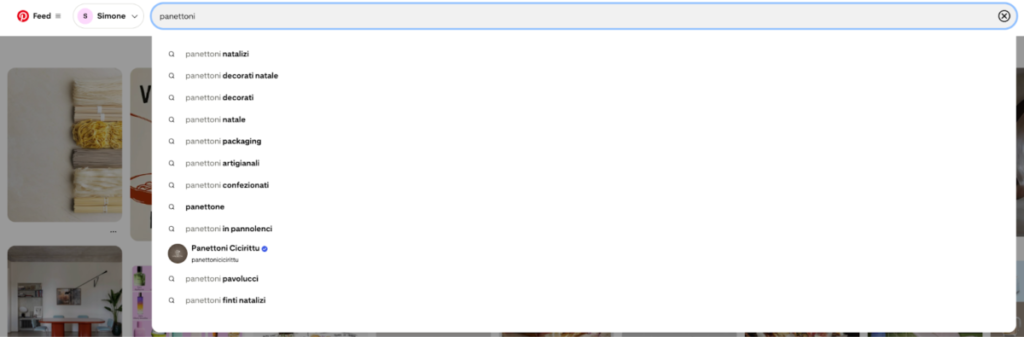
With an old client, we obtained strong conversions on Pinterest by simply publishing products and building a solid structure. If you go in-depth with this case study.
The strategy
Goals:
- Increase revenue from the products.
- Improve qualified organic traffic.
- Fix the most important technical issues.
- Improve the structure, contents, and visibility of the brand.
What we did:
- Analysis of the complete market.
- Conduct keyword research in depth.
- Audit SEO and competitor analysis.
- Activate link building and PR campaign.
- Strategy for content plan.
The contents had a strong influence on the results.
We planned a solid plan to write the article 6 months before the seasonality started because the content needs to be crawled, indexed, and ranked.
So, it’s better to anticipate.
In this part, AI helped us.
I don’t have a complete prompt, but I tried to replicate a similar one that I’ve used.
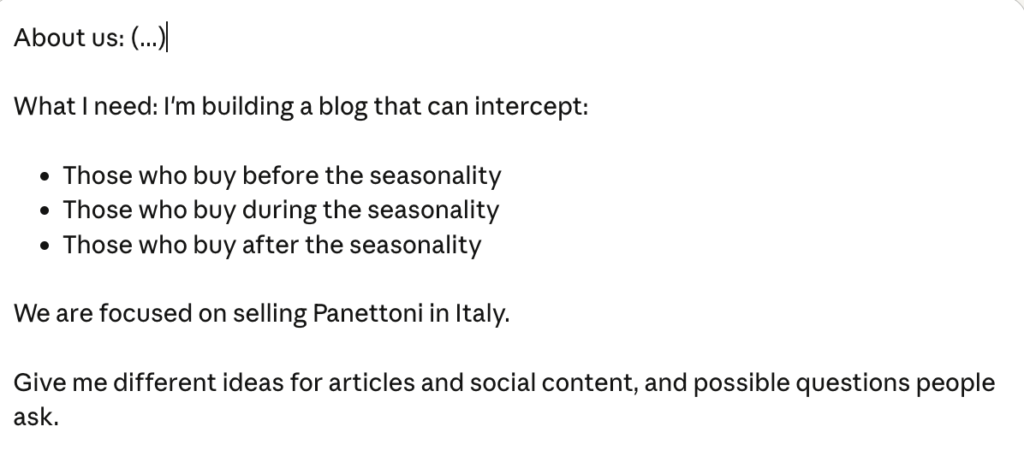
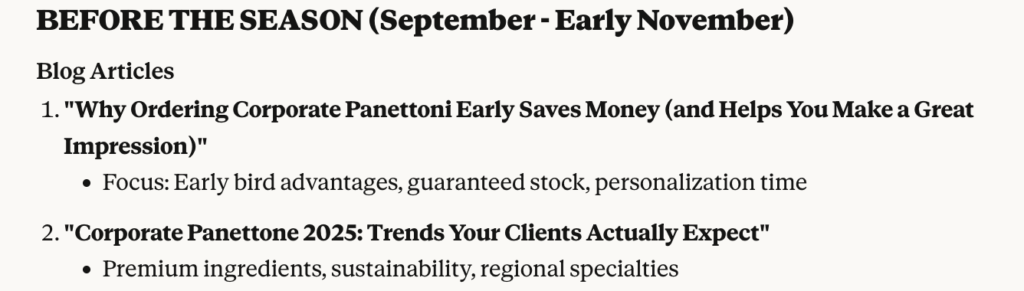
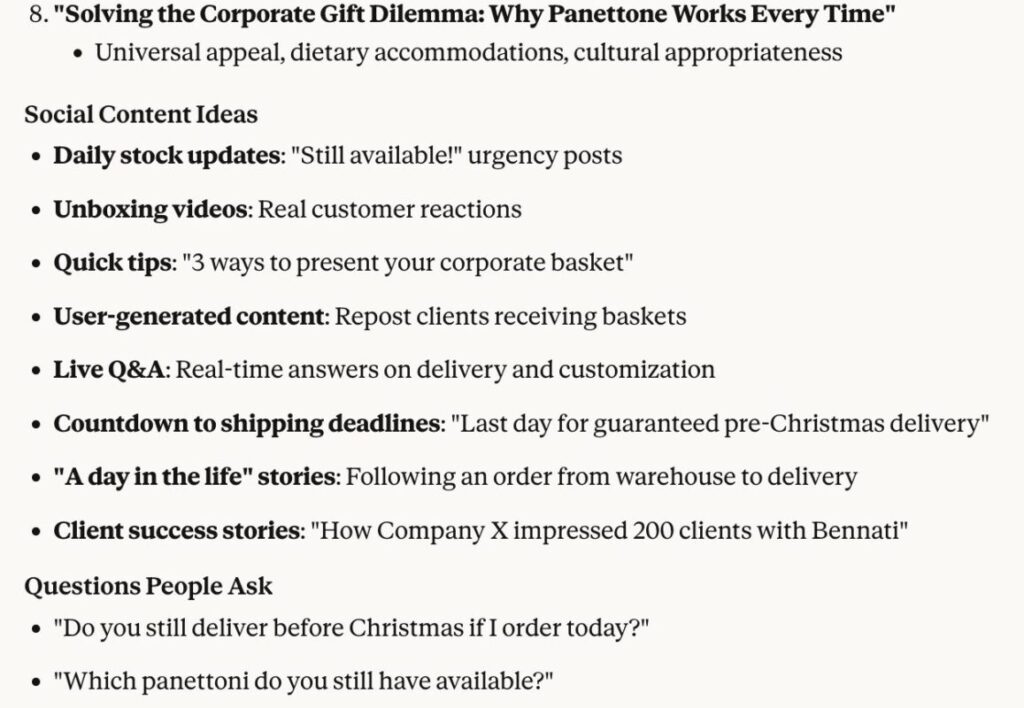
It is an example, but we can anticipate many doubts of people before they buy.
In fact, thanks to the content, we built a solid presence in the market, reminding people, “When you choose a Panettone/Cesto di Natale, etc,” you’ll choose us.
Results:
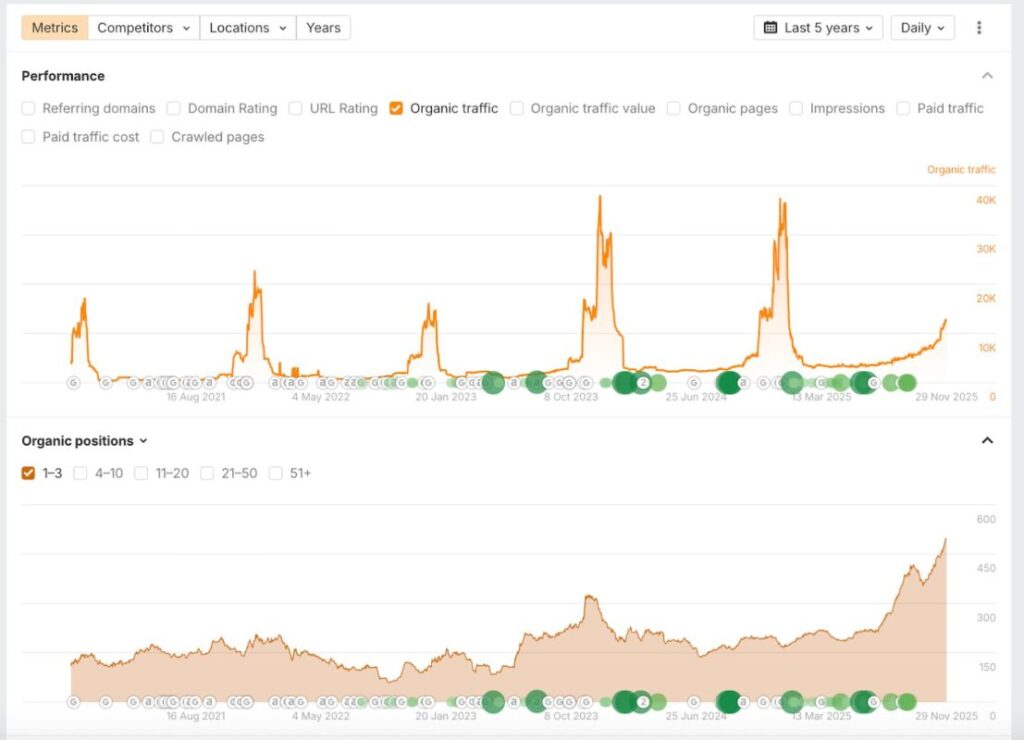
We are positioned in the top 1-3 on Google for the important keywords like:
- Strenne di natale
- Cesti natalizi
- Panettoni online
- …
Increased revenue from the products and improved authority of the brand.
Do you want to grow your eCommerce SEO seriously?
Contact me at simoneparodi@searchind.com